 EN
EN

In high-volume food production environments, every second and every gram of ingredient counts. Whether you run a bustling snack bar, a catering operation, or a commercial food manufacturing facility, the way you shape and fill your coxinhas directly affects your throughput, labor costs, and product consistency. A coxinha machine is specifically engineered to transform this traditionally labor-intensive process into a streamlined, automated workflow that dramatically reduces production time while maintaining the exact size, weight, and filling ratio that customers expect every single time.
Understanding exactly how a coxinha machine improves cooking efficiency requires looking beyond the obvious speed gains. It means examining how automation affects dough handling, filling portioning, labor allocation, product uniformity, and even downstream frying performance. This article explores the full operational impact of integrating a coxinha machine into a commercial kitchen or food production line, giving food business owners and procurement managers the insight they need to make confident equipment investment decisions.
The Core Efficiency Problem with Manual Coxinha Production
Why Hand-Shaping Creates Bottlenecks
Traditional coxinha production relies entirely on skilled hands. A trained worker must portion the dough, flatten it, add a precise amount of filling, seal the edges, and shape the piece into the characteristic teardrop form — all without tearing the dough or leaving air pockets. This process, when done by hand, typically takes between 20 to 40 seconds per piece depending on worker skill level and filling type.
When you multiply that time across hundreds or thousands of pieces per service shift, the bottleneck becomes critical. An experienced team of five workers might produce 1,500 coxinhas per hour under optimal conditions — but fatigue, inconsistency, and ingredient waste often reduce that figure considerably. The coxinha machine directly addresses this by executing every shaping and encrusting step mechanically, without variation or fatigue.
Beyond raw speed, there is the issue of skill dependency. Businesses that rely solely on manual shaping are vulnerable to staff turnover, training gaps, and variable output quality. A coxinha machine removes that dependency by encoding the desired product specification into mechanical settings, making high-volume output achievable regardless of workforce experience level.
Inconsistency and Its Hidden Costs
Inconsistent coxinha sizing is more than an aesthetic problem — it creates real downstream inefficiencies. Pieces that vary in size will fry unevenly, resulting in some being undercooked and others overcooked in the same oil batch. This forces operators to reduce fryer batch sizes, extend cooking times, or increase quality rejection rates, all of which erode productivity and profitability.
A coxinha machine produces pieces with tightly controlled weight, diameter, and filling-to-dough ratio. This dimensional consistency means every piece in a fryer basket behaves identically during cooking, enabling operators to set precise frying times and temperatures with confidence. The result is a measurable improvement in both cooking efficiency and finished product quality.
How a Coxinha Machine Accelerates Production Output
Automated Encrusting and Portioning Mechanisms
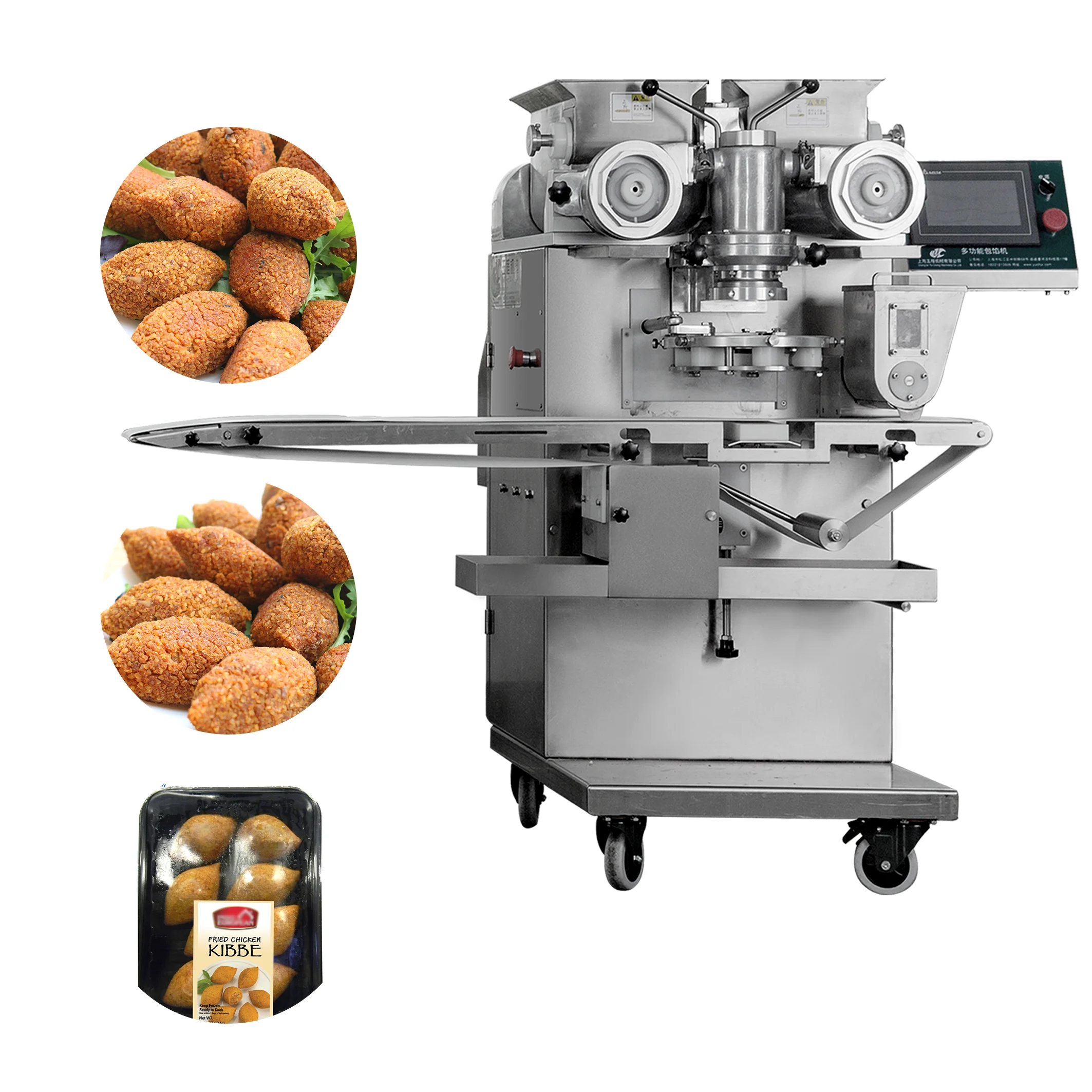
A modern coxinha machine operates through an encrusting mechanism that simultaneously portions the outer dough layer and injects the filling in a single synchronized action. The machine accepts pre-prepared dough and filling loaded into separate hoppers, then extrudes, fills, and seals each piece in one continuous mechanical cycle. This co-extrusion process is the foundation of the machine's speed advantage.
Depending on the model and mold configuration, a commercial coxinha machine can produce anywhere from 1,200 to over 3,600 pieces per hour. This output level is achievable with only one or two operators managing the loading and monitoring functions, compared to the five or more workers required for equivalent manual production. The labor-to-output ratio improvement is one of the most immediately quantifiable efficiency gains the equipment delivers.
The portioning precision of a coxinha machine also reduces ingredient waste. Manual portioning inevitably introduces variance — some workers use slightly too much dough, others too little filling. Over thousands of pieces, these small errors accumulate into significant material cost overruns. Machine portioning holds each component to a programmed specification, keeping food cost calculations accurate and predictable.
Continuous Operation and Reduced Downtime
Unlike human workers who require breaks, shift rotations, and recovery time during peak periods, a coxinha machine operates continuously as long as ingredients are supplied. This uninterrupted production capability is particularly valuable in operations that serve large volumes during compressed time windows, such as event catering, school feeding programs, or high-traffic retail snack counters.
The ability to sustain consistent output across a full production shift without degradation means that a coxinha machine effectively flattens the productivity curve. Businesses can plan their ingredient prep, frying schedules, and packaging workflows around a reliable, steady production rate — something that manual teams simply cannot provide with the same reliability.
Impact on Kitchen Workflow and Labor Efficiency
Redeploying Labor to Higher-Value Tasks
When a coxinha machine takes over the repetitive shaping and filling tasks, the kitchen staff who previously handled those duties become available for more complex or value-added work. In a commercial kitchen context, this might mean redirecting workers toward ingredient preparation, quality control, frying management, packaging, or customer-facing service roles.
This labor reallocation is a genuine efficiency multiplier. Rather than simply reducing headcount, smart operators use the coxinha machine to increase overall kitchen output by deploying the same number of workers across a broader range of productive tasks. The machine essentially adds productive capacity without adding labor cost, which improves the overall operational efficiency of the entire kitchen.
For food manufacturers operating at industrial scale, the impact is even more pronounced. A coxinha machine integrated into a production line can synchronize with upstream ingredient preparation equipment and downstream portioning or packaging systems, creating a coordinated workflow where human intervention is focused on supervision, maintenance, and logistics rather than manual forming.
Simplifying Training and Onboarding
One of the less-discussed efficiency gains of using a coxinha machine is the dramatic reduction in training time for production staff. Teaching a worker to hand-shape coxinhas to a consistent standard typically requires days or even weeks of practice. Operating a coxinha machine, by contrast, involves learning to load ingredients correctly, monitor machine performance, and perform basic cleaning procedures — skills that can be taught in a matter of hours.
This reduction in onboarding time directly translates to operational agility. Businesses can scale up production more quickly in response to demand spikes, accommodate seasonal workforce fluctuations without quality disruption, and maintain output levels even when experienced staff are absent. The coxinha machine effectively standardizes the production skill requirement, making the operation more resilient and less dependent on specialized culinary expertise.
Consistency, Food Safety, and Cooking Performance
Uniform Piece Size and Its Effect on Frying Efficiency
As mentioned earlier, the dimensional consistency delivered by a coxinha machine has a direct and significant impact on frying efficiency. When every piece enters the fryer at the same size and weight, the thermal transfer during frying is predictable and uniform. Operators can optimize their fryer settings for a specific piece specification, achieving ideal internal cooking and exterior crispness in a fixed time window without having to manage variation.
This consistency also improves fryer oil management. Uneven pieces that require extended frying times degrade oil quality faster and create more breading particulate that must be filtered. A coxinha machine's output, being dimensionally consistent, allows for cleaner, more controlled frying cycles that extend oil life and reduce frying medium costs over time.
Hygienic Production and Reduced Contamination Risk
A coxinha machine constructed with food-grade stainless steel components and smooth, easily cleanable surfaces supports better food hygiene standards compared to extended manual handling. Every hand contact with raw dough or filling is a potential contamination point. By minimizing the number of manual touches each piece requires, the coxinha machine reduces cross-contamination risk and makes it easier to maintain consistent hygiene protocols during high-volume production runs.
Machines designed with tool-free disassembly for daily cleaning make the sanitation process faster and more thorough, reducing the time kitchen staff spend on end-of-shift cleanup while ensuring food safety compliance. For operations subject to health inspections or food safety certification requirements, this is a meaningful operational and regulatory benefit.
Long-Term ROI and Operational Scalability
Calculating the Efficiency Return on Investment
The efficiency improvements delivered by a coxinha machine translate into concrete financial returns over time. The most direct savings come from reduced labor cost per unit produced — fewer workers are needed to achieve the same or greater output. Secondary savings accumulate through reduced ingredient waste, lower oil consumption due to optimized frying cycles, and decreased quality rejection rates.
For a business producing 5,000 coxinhas per day, even a modest reduction in labor requirement and a small decrease in per-unit ingredient waste can generate savings that recover the equipment investment within a single production year. The precise ROI timeline depends on production volume, local labor costs, and ingredient pricing, but the directional case for efficiency-driven payback is strong for any operation producing above a few hundred pieces daily.
Scaling Production Without Proportional Cost Increases
One of the most strategically valuable aspects of a coxinha machine is that it enables production scaling that is not linear with cost. Adding 1,000 more coxinhas per day to a manual production operation typically means hiring more staff, sourcing more workspace, and extending labor hours. Adding the same volume with a coxinha machine may only require adjusting operating hours or increasing ingredient preparation capacity.
This non-linear scaling dynamic is critical for businesses looking to grow revenue without proportionally growing overhead. It creates the conditions for improved profit margins at higher volume, which is the foundation of a scalable food business model. The coxinha machine is therefore not just a production tool — it is a strategic infrastructure investment that supports business growth.
FAQ
How many coxinhas can a typical coxinha machine produce per hour?
Output varies by machine model and configuration, but commercial coxinha machines commonly produce between 1,200 and 3,600 pieces per hour. The actual rate depends on piece size, dough consistency, and whether the machine is operating at single or multi-mold capacity. Operators should consult the manufacturer's specifications for their specific intended product size.
Does a coxinha machine work with different fillings and dough types?
Most commercial coxinha machines are designed with adjustable filling injection systems that can accommodate a range of filling types, including shredded chicken, cheese, and meat-based mixtures, as long as the filling has appropriate viscosity and does not contain oversized particles that could block the injection nozzle. Dough parameters such as hydration and elasticity may need adjustment depending on the recipe to ensure clean encrusting and sealing.
What maintenance does a coxinha machine require to sustain efficiency?
Routine maintenance for a coxinha machine typically includes daily cleaning of all product-contact surfaces, periodic lubrication of mechanical components, and regular inspection of sealing and extrusion parts for wear. Machines with stainless steel construction and modular disassembly design simplify daily sanitation. Following the manufacturer's recommended maintenance schedule is essential for sustaining production efficiency and extending equipment lifespan.
Is a coxinha machine suitable for small or medium food businesses?
Yes, coxinha machines are available in a range of capacities suited to different business scales. Smaller countertop or semi-automatic models are well-suited to cafes, bakeries, and catering operations producing a few hundred to a few thousand pieces per shift. Larger fully automatic models are designed for industrial food manufacturing environments. Selecting the right capacity for current and projected volume needs is the key decision factor for small and medium operators.


